How to Build a Wedding Budget You Can Actually Stick To
How to Build a Wedding Budget You Can Actually Stick To
Wedding budgeting gets difficult when you start with prices instead of priorities.
There will always be another upgrade, another idea and another thing you didn't realize weddings apparently require.
A useful wedding budget isn't about spending as little as possible. It's about deciding what matters to you, understanding what your wedding will realistically cost and making intentional choices before the expenses start piling up.
Here's how to build a budget you can actually use.
Start With the Real Number
Before booking anything, determine how much money is actually available for the wedding.
If family members have offered to contribute, have those conversations early.
Try to get specific.
“Don't worry, we'll help with the wedding” isn't a budget.
You need to know:
Who is contributing?
How much are they contributing?
Is the money available now or later?
Is their contribution intended for something specific?
Once you know those numbers, determine the total amount you're comfortable spending.
That is your starting budget.
Decide What Matters Most
Before assigning money to categories, each of you should identify the parts of the wedding that matter most.
Maybe it's:
An amazing venue
Great food
Photography
A packed dance floor
Beautiful flowers
A smaller wedding with an incredible honeymoon
Having everyone you love in one room
There isn't a correct answer.
If photography is incredibly important to you, budgeting more for an experienced photographer makes sense.
If elaborate flowers don't matter much, that's an obvious place to spend less.
A budget works better when it reflects your priorities, rather than someone else's idea of what a wedding should include.
Build the Guest List Early
Guest count affects much more than catering.
Every additional guest may affect:
Food
Drinks
Tables and chairs
Linens
Centerpieces
Invitations
Favors
Cake or desserts
Venue size
That's why guest count is one of the most powerful tools you have for controlling the overall wedding budget.
You don't need the final list immediately, but you need a realistic estimate.
Research Real Local Costs
Generic wedding-budget percentages can be useful as a starting point, but they aren't a substitute for actual prices in your area.
Research several local vendors in the categories that matter most to you.
You don't necessarily need formal quotes from everyone yet. You're trying to establish realistic ranges.
If you've budgeted $1,000 for something that consistently costs $2,500 locally, it's much better to discover that before you've spent the rest of the budget.
Separate Budgeted, Contracted and Paid
This is where wedding budgets often go sideways.
You may have budgeted $3,000 for photography.
Then you sign a photography contract for $3,500.
You pay a $1,000 deposit.
Those are three different numbers.
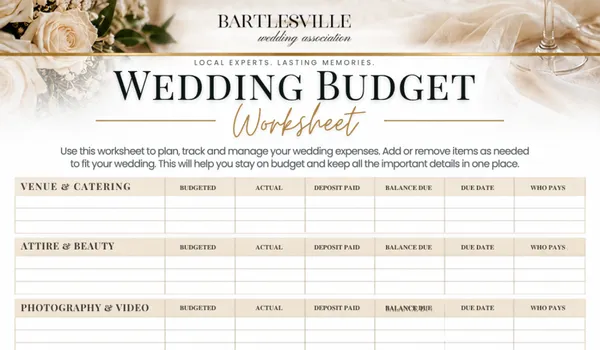
Your budget should track:
Budgeted: What you planned to spend.
Actual or Contracted: What you've committed to spending.
Paid: What you've already paid.
Balance Due: What you still owe.
If you only track deposits, your bank account can make you feel much richer than you actually are.
Our BWA Wedding Budget Worksheet is designed to help you track all four.
Don't Forget the Less Obvious Expenses
The big categories are easy to remember.
It's often the smaller expenses that quietly add hundreds or thousands of dollars to the final total.
Depending on your wedding, these could include:
Alterations
Delivery fees
Setup fees
Service charges
Gratuities
Marriage-license fees
Vendor meals
Transportation
Hair and makeup trials
Accessories
Signage
Postage
Rentals
Cake-cutting fees
Cleanup
Hotel rooms
Gifts
Last-minute supplies
Not every wedding will have all of these expenses.
The point is to leave room for things that aren't obvious when you first create the budget.
Leave Yourself Some Breathing Room
Try not to allocate every available dollar on day one.
Keeping a small portion of the budget unassigned gives you room for price changes, forgotten expenses and things you decide you really want later.
Otherwise, every unexpected $100 expense requires taking $100 away from something you've already planned.
A little flexibility makes the entire process less stressful.
Compare the Total Price, Not Just the Starting Price
A vendor's advertised or starting price doesn't always tell you what you'll actually spend.
One package may look more expensive but include things you'd otherwise have to purchase separately.
When comparing vendors, look at:
What's included
Number of hours
Staffing
Rentals
Delivery
Setup
Cleanup
Travel fees
Taxes
Service charges
Required add-ons
Compare the real final cost as closely as possible.
Update Your Budget Every Time You Book Something
Your wedding budget should be a working document.
When you sign a contract, update it.
When you pay a deposit, update it.
When the guest count changes, update it.
When you add something, update it.
Five minutes of tracking now can prevent a very unpleasant surprise a month before the wedding.
Know Where You Can Adjust
If the numbers start creeping upward, don't panic.
Go back to your priorities.
Look for expenses that aren't important enough to justify their cost.
Sometimes the answer is choosing a less expensive option.
Sometimes it's reducing quantity.
Sometimes it's skipping something entirely.
And sometimes you decide something is worth spending more on and intentionally reduce the budget somewhere else.
That's what budgeting is supposed to do: help you make decisions.
Your Wedding Doesn't Need Everything
This may be the most useful budgeting advice of all:
You do not have to include something simply because other weddings have it.
You don't need every trend.
You don't need every upgrade.
You don't need every tradition.
Spend money on the things that make your wedding feel like your wedding.
Skip the things you're only buying because you think you're supposed to.
Start Planning Your Wedding Budget
Use the BWA Wedding Budget Worksheet to keep your estimated expenses, actual costs, deposits, balances and payment dates together in one place.
Then, when you're ready to start getting real numbers, explore the Bartlesville Wedding Association Vendor Directory to connect with local wedding professionals who can help you understand your options and plan around your priorities.
A good wedding budget isn't about taking the fun out of planning.
It's what lets you know where you can say yes without regretting it later.
LOCAL EXPERTS. LASTING MEMORIES.